University of Pittsburgh Athletics
11/5/2026 10:00:00 AM | Football
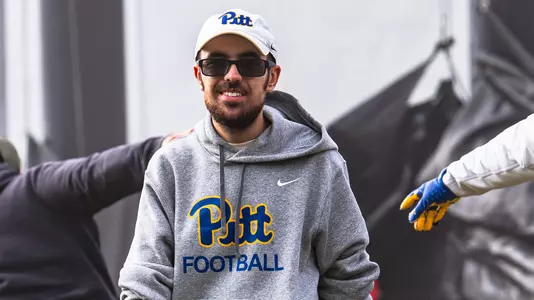
The horn sounded between periods six and seven, and Niko Pitinii knew what was coming.
He was holding the down marker inside Pitt's indoor facility, a job he'd done countless times as a student equipment manager. But he'd passed out a couple of weeks earlier, and he recognized the feeling creeping in. A teammate asked if he was okay.
"Take this," Pitinii said, handing off the marker.
Then he stumbled backward into the dustiest corner of the building and fell over.
It was December 2025, and the Panthers were preparing for the Go Bowling Military Bowl. Pitt's medical staff ran to him and sent him to the hospital. Bloodwork came back fine. Nobody could explain why a once-big kid from Canton, Ohio, had lost nearly 70 pounds, couldn't sleep and could barely eat.
Two days later, back in the ER, a CT scan answered the question before any doctor did. The result landed in his patient portal. He opened it and learned he had a tumor.
"Horrifying" is how he describes it now, though he can find the dark humor in how it happened.
By the time a doctor confirmed it hours later, his family was already in the room. Everyone, including the doctors, assumed it was benign.
A bed opened at Cleveland Clinic, and there, doctors found hydrocephalus, a fluid backup that explained the weight loss, the exhaustion and the hearing trouble.
It was so bad that when head coach Pat Narduzzi called to check on Pitinii, he couldn't even hear what Narduzzi had to say — still he appreciated the call.
On Dec. 23, surgeons built him a new pathway for the fluid to drain. The diagnosis came with it: germinoma, a rare form of brain cancer. Doctors told him he was roughly a week from dying had he not sought treatment.
That same day, Narduzzi called again.
Within a day or two, Pitinii's number was sent to the roster for anyone that wanted to reach out. Most of the players did. Coaches did. The team recorded a video at practice and dedicated the bowl game to him. The Panthers lost, but that wasn't the point.
"There were guys that I never really talked to before, and they texted me," Pitinii said.
One message still makes him laugh. It began, "Niko, this is Jeff Persi from Pitt O-line."
"Like, I know who you are, Jeff Persi," Pitinii said.
Pitinii spent January through June in treatment. He still thought, for months, that he was going to die.
He didn't believe otherwise until April.
He couldn't be left alone those first few months. His grandmother moved in. His mother, a lawyer, stepped back from work to care for him. He needed help getting to the bathroom and couldn't shower on his own. He carved out half a couch in his parents' living room, with sheets, pillows and anything else he needed.
His social life, from December through May, was his parents, his grandmother and his doctors.
"I cried a lot," Pitinii said. "Put that in the story. Men cry. It was hard and it was scary."
Asked how an equipment manager, someone whose entire job is taking care of other people, learned to be the one cared for, he didn't soften it.
"I was helpless."
He rang the bell at the end of treatment on July 9. In August, he walked back into the Pitt locker room just as players were fitting Guardian Caps onto helmets. He was told he didn't need to do anything yet.
That plan lasted until his stomach, still unsettled by treatment, started to turn.
"Not a good welcome back, in my opinion," he said.
But he was back.
He still doesn't sleep well some nights. On those mornings, he texts head equipment manager Brad Anderson to say he can't make it.
On better days, he goes to practice, though he's not yet cleared to help set up the field. Mornings start with physical therapy with athletic trainer Ada Weiss, who he says he can't thank enough.
Asked what returning to Pitt means to him, he started to answer, and then stopped. He struggled to put it into words.
"If I was told I couldn't come back," he said, "I probably wouldn't come back to school."
He's working to rebuild the strength he lost. Despite other reports, he did not change his major. He did add a minor in social work, moved by the oncology social worker who guided him through treatment.
He doesn't go to games. Saturdays are still too much.
What he can do is show up on Thursdays.
After wins, Pitt hands out dog tags to its players of the week, and the equipment staff gets a "Manager of the Week" honor, which comes with a speech. Pitinii earned his before the UCF game on Sept. 12.
Narduzzi asked him to address the team. Brad had given him a line to work with.
"Hey, if I can beat cancer, we can beat UCF."
The room erupted. Pitt beat UCF, 12-7.
Three weeks later, he got another surprise.
Director of Football Communications Mike Annarella called him into an office to tell him he'd been nominated for the 2026 Capital One Orange Bowl-FWAA Courage Award — an honor Pitt running back James Conner won in 2016.
Pitinii cried and asked to call his parents so the staff member could explain it to them too.
He doesn't expect to win. He's the only non-player on the list.
"But it gives me something to look forward to," he said.
It's a long way from that practice almost a year ago. The fight is still going, but it's moving in the right direction, and for now, he's just happy to be back with the team.