University of Pittsburgh Athletics
The Lesson Behind Curtis Aiken's Hall of Fame Career
7/22/2026 12:55:00 PM | Men's Basketball
A few years ago, former Pitt basketball star Curtis Aiken found himself on a golf course with Santonio Holmes. Two Pittsburgh legends from different eras and different sports, swapping stories in the middle of a round.
Somewhere in the conversation, Holmes brought up Aiken's career at Pitt, and told him something that stuck.
"One thing you always dream about is to make an impact where it's everlasting," Aiken said. "[Holmes] congratulated me, and he said, 'Hey, you'll always be remembered.'"
Aiken had never really thought about it that way.
He wasn't chasing a legacy when he signed with Pitt out of Buffalo. He was chasing a chance to play in the Big East, on the stage he grew up watching. But three decades later, on a golf course with a Super Bowl MVP, it was clear the legacy had found him anyway.
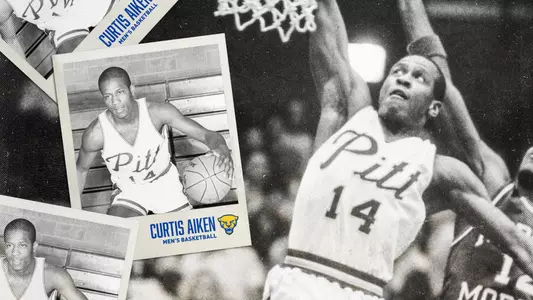
This fall, Aiken will be inducted into the Pitt Athletics Hall of Fame, a career that started with a decision most people around him questioned and turned into one of the most decorated four-year runs in program history.
A Risk Worth Taking
When Aiken signed with the Panthers in the early 1980s, he did it as the program's first-ever All-American commitment, a signal that Pitt basketball intended to be taken seriously.
That was not the consensus opinion at the time. Pitt was known as a football school, and plenty of people around Aiken questioned why a player of his caliber would choose it over a program like Syracuse, which had also recruited him hard out of Buffalo.
Aiken saw it differently. He had grown up watching Big Monday on ESPN, the weekly doubleheader that showcased the Big East at its best, and he wanted in on that stage — but he wanted it at Pitt.
"Pitt was a team that I felt like I could bring my talents to really help win the Big East championship, which we ultimately did," Aiken said.
Syracuse wasn't happy he decided to take his talents to the Panthers. Aiken was familiar with playing in the Carrier Dome and familiar with the Syracuse coaching staff, and he knew it was an unpopular decision.
What followed was a rivalry that Aiken carried with him every time the two teams met. Pitt's slogan at the time was simple, and it became personal to him.
"Every time we played Syracuse, I wanted to prove to their coaching staff that we could beat them," Aiken said. "That was our slogan back then. Pitt is it."
He leaned on that phrase every time Pitt played Syracuse, using it as fuel to prove the decision had been the right one. It became less about beating an opponent and more about validating a bet on a program that had not yet given anyone a reason to believe.
That bet started paying off almost immediately, and it kept paying off through four NCAA and NIT tournament appearances. But the biggest validation of Aiken's decision came in his senior season, when Pitt won a share of its first Big East regular-season title and set what was then a school record with 25 wins.
The football school with the newly minted All-American had turned into a Big East contender, and everyone who doubted the move had their answer.
Learning to Step Back
Aiken arrived at Pitt as a scorer.
In high school, he averaged more than 40 points a game and led the nation in scoring on his way to a state championship.
That instinct did not disappear at Pitt, and it did not need to. He still put up a career-high 14.2 points per game as a senior and was named MVP of both the 1985 Sugar Bowl Classic and the 1986 Rainbow Classic.
He dropped a career-high 39 points against Arkansas en route to being crowned Rainbow Classic champions.
And he did it all without a 3-point line.
"He was dominant," longtime Pitt play-by-play announcer Bill Hillgrove said. "That's the kind of player he was. He certainly made more than a splash at Pitt."
But averaging 40 points on your own team in high school and winning games in the Big East are not the same skill, and Aiken had to learn the difference.
Pitt made just the NIT during his early years, a result Aiken felt fell short of what the roster was capable of, and he traced the shortfall back to a simple problem.
"We should have probably made the NCAA Tournament, but we just didn't play as a team," Aiken said. "As one of the leaders on the team, I had to make sure that everyone understood that we had to do it as a team, and that was my approach."
He needed everyone pulling in the same direction. That shift showed up on the floor his senior year, when Pitt had one of the best rebounders in the country in Jerome Lane, a dominant low-post scorer in Charles Smith and a dynamic offensive threat in Demetrius Gore.
Aiken did not need to be the only option anymore, and the team was better for it. Pitt's Big East title and 25-win season were not built on one player doing more. They were built on players who had learned to need each other.
"There was a lot of buzz for a while there in the '80s," Hillgrove said. "The Steelers weren't that good. The Pirates weren't that good. It was the hottest ticket in town to go to the Field House and watch those guys play. It was a magical moment in the history of Pitt basketball."
A Legacy Built to Last
Aiken has carried that same mentality into life after basketball. He built a business in Pittsburgh, and later a building on Babcock Boulevard that today houses his family, his offices and his club.
He named it the Marion Building, after the grandmother who raised him back in Buffalo, a decision that says as much about who Aiken is as anything he did on the court.
He has also stayed close to the city that embraced him as a player. Aiken has said that being part of a Pitt network helped open doors for him as a young professional, and that there is something distinct about doing business in a city where people share a connection to the same university, even decades removed from playing days.
"It's just been a great ride," Aiken said. "One of the great honors that I've ever had was to wear a Pitt uniform and to represent Pitt."
That thread, choosing Pitt when it was not the obvious choice and then learning to make the people around him better once he got there, runs through everything Aiken has done since.
It's why a program once dismissed as a football school ended up with a Big East championship banner. It's why a Buffalo kid who once averaged 40 points a game is remembered instead for what he gave up to help his team win.
Thirty years later, on a golf course, that was the thing Santonio Holmes wanted him to know. Aiken has never forgotten it.
This story is part one of an eight-part series profiling Pitt Athletics' 2026 Hall of Fame class. Check back on pittsburghpanthers.com throughout the coming weeks as we spotlight each inductee ahead of their induction.