University of Pittsburgh Athletics
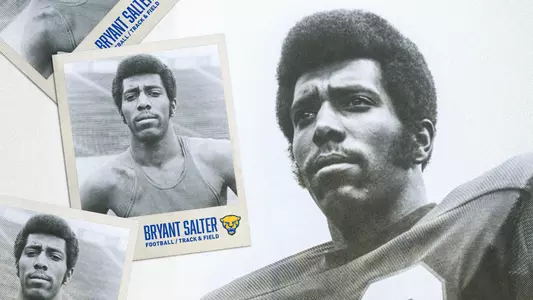
From Track Star to Diplomat: Bryant Salter's Journey Beyond the Field
8/3/2026 1:00:00 PM | Football, General, Men's Track & Field
Bryant Salter never wanted to be known as just a football player.
Long before he became a U.S. diplomat serving 21 years with the State Department, before he coached Olympic hopefuls across Africa and even before he intercepted six passes as an NFL rookie, he was simply a track and field athlete who happened to also play football at Pitt — almost as an afterthought.
Salter arrived on campus in 1967 on a track scholarship, and that distinction mattered more than anyone realized at the time. The football program wasn't looking for additional players, and coaches weren't inclined to make room for a walk-on. So Salter set a condition of his own: he wouldn't enroll unless someone let him suit up for football, too.
"I was considered a walk-on, and they didn't want any additional players," Salter said. "They had the team that they wanted. So, I told the track coach that I wouldn't come unless they would let me play football."
The track coach took the request up the chain, all the way to Chancellor Wesley Posvar, who settled the matter with a simple directive: give the kid a helmet and shoulder pads.
It was permission, not enthusiasm and Salter's early tryouts reflected exactly that. Stationed at wide receiver, he ran routes all morning and never saw the ball come his way. By that afternoon, he'd switched to defense, where his very first hit sent an opposing player to the ground, ball and helmet flying in opposite directions.
That collision set the tone for the rest of his football career. Salter became a defensive back, and after a couple of years working his way up, he finally earned a starting role.
By 1970, he led the team in interceptions with four and was named a UPI First Team All-East defensive back. It was remarkable production for someone who, by his own account, was never really a football player at heart.
"I was always a track guy who played football," Salter said. "The track was more influential than anything else... I never really got out of condition all year round, where some people may have put on weight or whatever, but I never had to do that."
That conditioning showed up on the track in dramatic fashion.
Salter set program records in the high jump and triple jump, earned All-America honors in both events, and placed third in the triple jump at the 1970 NCAA Outdoor Championships.
He credits an early trip to the NCAA Championships in San Francisco that he took as a freshman with giving him the composure to compete at that level again just a few years later.
His football instincts, meanwhile, were sharpened by an unconventional summer lesson. After his freshman year, Pitt wanted to offer him a football scholarship, but the track coach said no — so Salter stayed on his original scholarship.
That didn't stop his backfield coach from showing up at his house that summer to teach him something unusual: how to run backward as fast as he could run forward, so he could keep his eyes on the quarterback instead of blindly retreating.
The payoff came against Notre Dame, when Salter was assigned to shadow the Fighting Irish's star tight end. He was a frequent target of then quarterback Joe Theismann and scored a touchdown in every game that season.
Salter held him without one.
"He did catch eight or nine passes, and he had less than 100 yards, so that was successful," Salter said. "Unfortunately, the jersey I was wearing got torn in the first part of the game, and they switched to a different jersey from some other guy on the team, so I had a completely different number... they kept calling me Steve Demerk."
The San Diego Chargers drafted Salter in the fifth round, and he played six professional seasons — including a rookie year in which he started seven games and picked off six passes, a stretch he still attributes to that backward-running lesson from his Pitt coach. But professional football wasn't the destination. It was a bridge to something else entirely.
A year after retiring from the NFL, Salter left football to work for the State Department.
The decision traced back to a formative experience: volunteering as an assistant coach for a Pan-African track and field training camp ahead of the 1976 Olympics, where he spent nearly six months in Africa working with athletes from ten different countries.
There, conversations about identity and country stuck with him.
"I decided that I would leave football to represent my father, my family, my city, my state, my country to the people that I would meet overseas," Salter said. "I decided that was much more important than winning a Super Bowl."
That decision set him on a path to law school at the University of San Diego and, eventually, a 21-year diplomatic career, including a post as U.S. Consul General in Argentina.
He credits Pitt not for the athletic scholarships that got him there, but for the education that gave him the tools to become a lawyer and, later, a diplomat. Decades after he left, it was another Pitt chancellor, Mark Nordenberg, who tracked him down in Argentina and eventually brought him back into the university's orbit, this time as a member of the board of trustees.
Ask Salter how a two-sport college athlete becomes a career diplomat, and his answer is always the same.
"I graduated from the University of Pittsburgh."
This story is part three of an eight-part series profiling Pitt Athletics' 2026 Hall of Fame class. Check back on pittsburghpanthers.com throughout the coming weeks as we spotlight each inductee ahead of their induction.