University of Pittsburgh Athletics
Marcedes Walker's Numbers Tell One Story Her Belief Tells Another
8/31/2026 5:00:00 PM | Women's Basketball
Marcedes Walker's Numbers Tell One Story Her Belief Tells Another
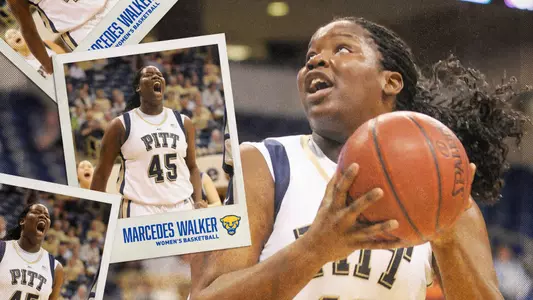
Every rebuild needs a first believer. For Pitt women's basketball in the mid-2000s, that believer wore number 45 and stood in the paint, grabbing every rebound within reach.
Marcedes Walker arrived at Pitt in 2004 as part of Agnus Berenato's second recruiting class, walking into a program that had won six games the year before she got there.
She left four years later as the program's all-time leading rebounder and sixth all-time leading scorer, a three-time All-Big East selection who helped guide the Panthers to three straight postseason appearances, capped by a Sweet 16 run in 2008.
On September 11, Walker will be inducted into the Pitt Athletics Hall of Fame, closing the loop on a legacy that started long before the trophies did.
Jen Tuscano, Pitt's Executive Associate Athletic Director for Internal Operations, was Walker's academic advisor and remembers the earliest version of the rebuild, back when belief was the only currency the program had to offer.
"If I look back and reflect on how Coach Berenato was able to begin the rebuild of the women's basketball program, I would say it started with Marcedes Walker, Shavonte Zellous and the incredible coaching staff Coach Berenato assembled," Tuscano said.
That rebuild almost didn't happen. Walker's recruitment nearly stalled over a paperwork issue that had nothing to do with basketball. Her high school, University City, hadn't kept its class registrations updated with the NCAA Clearinghouse, which put her eligibility in jeopardy before she ever set foot on campus.
Berenato didn't let it slide. She dug through the coursework herself, contacted the clearinghouse and pushed the school to get Walker's credits recognized. Then she showed up at Walker's grandmother's house to make a promise in person.
"She had my back the whole way," Walker said. "Coming and sitting at my grandma's house, telling my grandma she was gonna make sure I'm okay, and that she was gonna make sure that I got a degree and everything else."
That kind of investment doesn't disappear once a player signs. It compounds. Walker arrived in Pittsburgh as a freshman with the weight of a program transition on her shoulders, expected to anchor a team that had nowhere to go but up. She remembers the nerves. She also remembers how quickly they gave way to responsibility.
But Coach Berenato really trusted in her, so she knew she had at least a foundation.
Walker averaged a double-double as a freshman, pairing her natural scoring instincts with the rebounding toughness her post coach demanded of her. By her senior year, she was closing in on a milestone nobody in program history had touched.
"My senior year, he was like, 'Cedes, if you play strong, you can be the only player that has 2,000 points and 1,000 rebounds, and I'm pretty sure no one will break that record,'" Walker said.
She finished with 1,870 points and 1,162 rebounds, one of only two players in program history to clear both the 1,000-point and 1,000-rebound thresholds.
But the number that mattered most to Tuscano wasn't on a stat sheet. It was the shift she watched happen in real time, as a program that had been rebuilding in theory started rebuilding in practice, because one player had decided to trust it.
"It was impressive to watch," Tuscano said. "The belief that Coach Berenato and Marcedes had in each other was a major part of the foundation in rebuilding the women's basketball program. Marcedes became one of the program's best recruiters. Her success at this level allowed others to believe they could be successful at this level too."
Walker's belief in the coaching staff became the blueprint. Berenato and her assistants could develop talent all they wanted, but development only sticks when players buy into the people developing them. Walker bought in first, and the locker room followed her lead.
That trust showed up in the record book. Pitt reached the WNIT Final Four in 2006, the NCAA Tournament in 2007 and the Sweet 16 in 2008, each season building on the one before it.
Walker felt the shift happen from the inside, watching a roster that had once been unproven grow into a group that expected to compete with anybody.
"When we made it to the WNIT, it was just like we were supposed to be there," Walker said. "So then we made the NCAA tournament the next year. But when we went to the Sweet 16, it was like, damn, you really did elevate each year you were at Pittsburgh, and that's all you can ask for when someone believes in you and wants you to come trust your program."
Tuscano saw Walker's voice carry as much weight as her stat line, especially in moments that had nothing to do with game action.
"Her voice in the locker room, her connection with her teammates, her connection when we hosted recruits was just as pivotal as it was with our own team," Tuscano said. "She had the belief and she had the voice, but she also had success on the court."
Walker's basketball career didn't end at Pitt. She played professionally for the WNBA's Houston Comets before a decade-long career overseas, and in 2024 she represented Azerbaijan as an Olympian in 3-on-3 basketball, with five family members flying in to watch her compete.
Nearly two decades removed from her final game in a Pitt uniform, Walker still hears from the coach who fought to get her there in the first place.
"Coach Berenato still to this day, she'll call me like twice a month, three times a month," Walker said. "'You got it, big girl. You're gonna do it.' Coach Berenato plays a real big part of my life from back in college to now."
When the Hall of Fame call finally came, Walker's mind went where it always goes.
"I just called my grandma right away, and her excitement made me more excited because I do everything for my family," Walker said. "God put me in the position to do this stuff, but really, I do it for my family."